
Government Performance Is Reality, Not Explanations, Press Releases, Noise

In Nigeria, we have become exceptionally good at explaining economic progress to people who are struggling to experience it.
There is something fascinating about governance in Nigeria. A government can deliver an impressive speech about economic recovery while millions of households are quietly calculating how to survive until the next payday. Officials can celebrate improved macroeconomic indicators while families struggle with food prices, electricity bills, school fees and rising transportation costs. Apparently, the economy is doing better, even when the average Nigerian is still negotiating with his bank balance.
Perhaps we have misunderstood the purpose of government. Or perhaps those in government have perfected the art of making governance sound considerably better than it feels.
Government should be judged by the conditions under which its people live, not by the eloquence with which its leaders explain those conditions.
The responsibility of government is not to manufacture impressive headlines, commission projects for television cameras or produce economic narratives that sound reassuring at international conferences. It is to create an environment where citizens can live with dignity, businesses can thrive, opportunities are accessible and tomorrow holds a reasonable promise of being better than today.
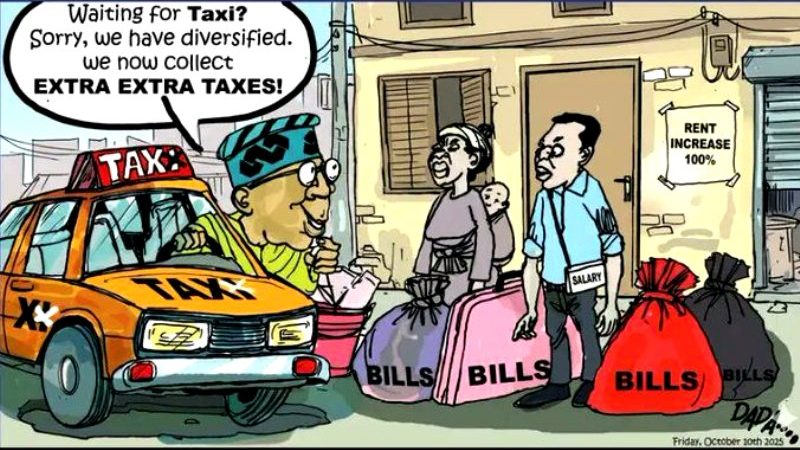
Consider the everyday Nigerian experience. Food, transportation, accommodation, healthcare and education are competing aggressively for the same limited household income. Inflation may be moderating, but Nigerians understand the difference between prices increasing more slowly and prices actually becoming affordable. The government may celebrate disinflation, but the market woman is still calculating her replacement cost. The civil servant is still wondering how his salary will survive the month.
Perhaps we should introduce another national economic indicator: the number of days an average Nigerian salary can survive after payday. That might generate more uncomfortable conversations than some of our economic presentations.
Then comes insecurity. What does agricultural growth mean to a farmer who cannot safely access his farmland? What does economic expansion mean to a community living under the threat of kidnapping? A country cannot genuinely prosper when ordinary activities such as farming, travelling, schooling and conducting business require extraordinary courage.
But there is another sector that deserves particular attention in this governance conversation: aviation. Nigeria’s aviation industry is often presented as a symbol of national ambition and economic connectivity. We celebrate airport remodelling, terminal inaugurations, international route announcements and ambitious plans to position Nigeria as a regional aviation hub. These are important developments. However, the real question is whether the aviation ecosystem is becoming more efficient, competitive, affordable and commercially sustainable.
What does a beautiful airport terminal mean if passengers still encounter poor access roads, inadequate ground transportation, inconsistent passenger services and operational bottlenecks? What is the value of impressive airport architecture if the passenger experience begins with traffic congestion, parking challenges and an expensive journey to the terminal?
We seem to have developed a peculiar national affection for infrastructure that photographs beautifully, even when the experience of using it tells a different story.
What about the airlines? Nigerian carriers operate in an exceptionally challenging environment characterized by high fuel costs, foreign exchange exposure, expensive aircraft financing, multiple charges, infrastructure limitations and significant operational risks. These pressures eventually find their way into ticket prices, airline sustainability and the wider cost of doing business.
We cannot genuinely aspire to become a regional aviation powerhouse while making it increasingly difficult for airlines to operate profitably, passengers to afford travel and investors to commit long-term capital.
Aviation is not simply about aircraft taking off and landing. It supports tourism, trade, investment, employment, hospitality, logistics and national competitiveness. Airports should function as economic gateways, not merely places where passengers arrive, queue, complain and depart.
If government wants aviation to contribute meaningfully to economic development, the conversation must move beyond terminal construction and airport inaugurations. We need commercially viable airport infrastructure, efficient regulation, competitive operating costs, improved safety and security, stronger domestic airline capacity, sustainable financing and deliberate tourism development.
The same principle applies across other sectors. Commissioning a road is an activity. Delivering a durable road that reduces transportation costs is performance. Announcing a job creation programme is an activity. Creating sustainable employment is performance. Approving a healthcare budget is an activity. Providing accessible and affordable healthcare is performance.
There is a difference between announcing intention and delivering impact.
To be fair, Nigeria inherited significant structural problems, and economic reforms are rarely painless. Fuel subsidy removal, foreign exchange reforms and fiscal adjustments required difficult decisions. But acknowledging the necessity of reform does not excuse government from accountability for its consequences.
Citizens cannot be asked to make sacrifices indefinitely without seeing measurable improvements. Patience is not an economic policy. Neither is patriotism a substitute for food, electricity, employment, security or affordable transportation.
As another electoral cycle approaches, we will hear impressive speeches, ambitious promises, carefully selected statistics and elaborate explanations of inherited challenges. There will probably be another round of commissioning ceremonies. Hopefully, someone will remember to invite the people who are actually supposed to benefit.
Nigerians must begin asking harder questions. Are households better off? Are businesses more productive? Are our airports more efficient? Are airlines operating in a more sustainable environment? Are roads safer? Is electricity more reliable? Are young people finding meaningful employment? Are public resources translating into measurable improvements in living standards?
These are not opposition questions. They are citizenship questions. Ultimately, the performance review of any government is not conducted in the State House, ministerial conference rooms, airport inauguration ceremonies or international economic summits. It happens every morning in Nigerian homes, markets, hospitals, farms, workplaces and airports.
A GOVERNMENT CAN WIN THE ARGUMENT AT A PRESS CONFERENCE AND STILL LOSE THE CONFIDENCE OF THE PEOPLE AT THE DINNER TABLE.
History will not remember the eloquence of every government speech. It will remember what life was like for the people who had to live under that government. And that, ultimately, is the only scorecard that matters.
WRITTEN BY MR. GBENGA ONITILO