
Attention Nigeria! What Drug Abuse Is Doing To Young People
Every now and then, a story breaks that reminds us how close this problem is. A young man collapses at a party after mixing codeine syrup with alcohol. A university student overdoses on tramadol, taken to stay awake for an exam. A teenager is arrested with a stash of Colorado cannabis mixed with tobacco. These are not isolated tragedies. They are symptoms of a global drug crisis that has found fertile ground among young people.
The World Drug Report by the United Nations Office on Drugs and Crime paints a worrying picture. In 2023, an estimated 316 million people aged 15 to 64 used a drug, excluding alcohol and tobacco. This is more than a 20 percent increase since 2013 and outpaces global population growth. About 64 million people worldwide were living with drug use disorders that year, and at least 450,000 deaths were linked to drug use in 2021. Perhaps most troubling, only about 1 in 12 people with a drug dependency received any treatment. That gap between need and care is where most of the damage happens, quietly, far from the headlines.
Cannabis remains the most widely used drug globally, with 244 million users, followed by opioids, amphetamines, cocaine and ecstasy. What should worry Nigeria is the direction of travel. Synthetic drugs, cheaper and easier to smuggle than plant-based narcotics, are spreading fast. Sadly, West Africa is becoming both a transit corridor and, increasingly, a production zone in its own right.
Now, Nigeria’s own numbers are, frankly, alarming. Drug use here runs at nearly three times the global average, with more than 3 million people living with drug use disorders. Between 20% and 40% of Nigerian youths, and around 20.9% of students, are estimated to be battling addiction. Even these figures are thought to understate the true picture, since drug circulation tends to happen quietly, away from official records. The substances most commonly abused include tobacco, cannabis, cocaine, diazepam, codeine, and amphetamines.
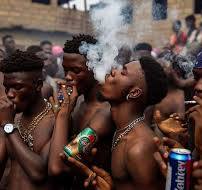
What makes the Nigerian situation more worrisome is how ordinary it has become. In many urban centres, drugs are woven into everyday social life rather than confined to hidden corners. Cakes, biscuits, and drinks laced with drugs show up at parties, promoted as part of the fun. Weddings and burial ceremonies in some communities now come with an unspoken expectation that something stronger than palm wine will be available. Unfortunately, a habit that has become normalized stops being treated as a health problem and starts being treated as a lifestyle choice.
The truth is that social media has added a new dimension to the problem. Content creators, musicians, and influencers routinely glamorize drug use, whether directly or through suggestion. Young Nigerians are among the most digitally connected people on the continent and quickly absorb these cues. In Lagos alone, around 40% of young people are reported to procure drugs through social media. A generation raised on skits and music videos that normalize substance use is now the same generation filling out the addiction statistics.
Access is the other side of the problem. Some pharmacies in Abuja have been found to illegally dispense codeine, while open markets and hawkers make cannabis easy to obtain. Tramadol abuse runs at around 37% among university students in Lagos, often taken to cope with academic pressure. In rural areas, economic hardship, unemployment, and, in the northeast, the trauma of conflict push people towards self-medication. Opioids are used to numb physical and psychological pain. Treatment capacity there remains inadequate or sometimes unavailable.
The truth is that the health consequences are real. Chronic drug use damages the heart, liver, and respiratory system. It equally raises the risk of mental health conditions, which include anxiety, depression, and, in severe cases, drug-induced psychosis. Young people who start using drugs in their teenage years are particularly vulnerable, since the adolescent brain is still developing. Cognitive decline, poor academic performance, and a greater likelihood of accidents and violence often follow. Families absorb the fallout too, in broken relationships, financial strain, and, in the worst cases, the loss of a young life that has barely begun.

None of these excuses negates individual choice entirely. Nigeria’s youth are not merely passive victims of a hostile environment. Many know a habit is destructive long before it slithers into dependency. The decision to reach for a bottle, a tablet, or a wrap still belongs to the person making it. Choosing not to experiment, recognising the early signs of dependency, and asking for help before things spiral are choices only the individual can make. No policy can substitute for that. However, responsibility works both ways. It is unreasonable to expect self-control from a generation raised in an environment that markets drugs as fun and sells them without a prescription. Young people bear some responsibility for their choices, and the state and society bear responsibility for the conditions that make those choices so easy to make badly.
Again, it would be easy to place all the blame on weak enforcement, and there is some truth in that view. Nigeria has a reasonably comprehensive legal framework, from the NDLEA Act to the National Drug Control Master Plan. Yet implementation lags far behind the scale of the problem. The National Drug Law Enforcement Agency has stepped up its efforts recently, arresting tens of thousands of suspects and running sensitization programmes in schools, religious centres, and workplaces. That outreach is essential. However, arrests alone will never solve a problem rooted in poverty, unemployment, peer pressure, and untreated mental distress. Enforcement must be matched by serious investment in treatment and rehabilitation.
The truth is that the solution to the problem is not a single one. What is needed is a combination of approaches. Public education should speak honestly to young people rather than lecture them. Economic opportunities should give purpose to those most at risk. Treatment services should be properly funded and made available in every region. Drug outlets and pharmacies should be diligently monitored and held accountable. Parents and teachers, as well as religious and community leaders, have a role to play in breaking the culture of silence that treats drug use as something to be laughed off rather than confronted.
Nigeria’s youth population is its greatest asset. Losing that potential to a preventable public health crisis would be a tragedy this country cannot afford. The conversation, therefore, needs to move beyond enforcement statistics to the harder work of prevention, treatment, and genuine care. That work will not make headlines the way a drug bust does. It is, however, the only thing that will actually change the trajectory.
WRITTEN BY SYLVESTER OJENAGBON, A HEALTH COMMUNICATION EXPERT AND CERTIFIED MANAGEMENT TRAINER, PUBLISHED IN THE CABLE 12/8/26 (Lead photo from Modern Ghana)